Look at what Daniel Pink has to say about mastery in Drive:
If you believe intelligence is a fixed quantity, then every educational and professional encounter becomes a measure of how much you have. If you believe intelligence is something you can increase, then the same encounters become opportunities for growth. In one view, intelligence is something you demonstrate; in the other, it's something you develop. The two self-theories lead down two very different paths -- one that heads toward mastery and one that doesn't. For instance, consider goals. [Carol] Dweck [a psychology professor at Stanford University] says they come in two varieties -- performance goals and learning goals. Getting an A in French class is a performance goal. Being able to speak French is a learning goal. "Both goals are entirely normal and pretty much universal," Dweck says, "and both can fuel achievement." But only one leads to mastery. In several studies, Dweck found that giving children a performance goal (say, getting a high mark on a test) was effective for relatively straightforward problems but often inhibited children's ability to apply the concepts to new situations. For example, in one study, Dweck and a colleague asked junior high students to learn a new set of scientific principles, giving half of the students a performance goal and half a learning goal. After both groups demonstrated they had grasped the material, researchers asked the students to apply their knowledge to a new set of problems, related but not identical to what they'd just studied. Students with learning goals scored significantly higher than on these novel challenges. They also worked longer and tried more solutions. As Dweck writes, "With a learning goal, students don't have to feel that they're good at something in order to hang in and keep trying. After all, their goal is to learn, not to prove they're smart." (119-120) Now consider this blog post on how project-based learning leads to mastery: How Project-Based Learning Develops Drive and Mastery
Daniel Pink's book Drive has been recommended to us many times, but we've been so obsessed with Frank Moss' The Sorcerers and Their Apprentices that we hadn't had time to pick it up. That changed recently, and now we feel compelled to share some of the fascinating ideas in the book that directly mesh with our philosophies. For a test drive of Drive (don't worry, we won't bombard you with driving puns; we promise to use them sparingly.), check out the RSA Animate video narrated by Pink:
Chapter One of Drive
As you may know, RealSchool is all about student-driven, passion-based learning, and so we were immediately taken with Pink's notion that jobs in the 21st century have become and will continue to become "more complex, more interesting, and more self-directed."
Pink writes:
Behavioral scientists often divide what we do on the job or learn in school into two categories: "algorithmic" and "heuristic." An algorithmic task is one in which you follow a set of established instructions down a single pathway to one conclusion. That is, there's an algorithm for solving it. A heuristic task is the opposite. Precisely because no algorithm exists for it, you have to experiment with possibilities and devise a novel solution. Working as a grocery clerk is mostly algorithmic. You do pretty much the same thing over and over in a certain way. Creating an ad campaign is heuristic. You have to come up with something new. During the twentieth century, most work was algorithmic . . . . The consulting firm McKinsey and Co. estimates that in the United States, only 30 percent of job growth now comes from algorithmic work, while 70 percent comes from heuristic work. A key reason: Routine work can be outsourced or automated; artistic, empathic, nonroutine work generally cannot. . . .
Partly because work has become more creative and less routine, it has also become more enjoyable. (27-29) And . . . Routine, not-so-interesting jobs require direction; non-routine, more interesting work depends on self-direction [our italics] (30). So! What are educators doing to make sure their classrooms are not places where algorithmic tasks take place, but rather where students participate in heuristic, creative, and self-directed work?
Additional Resources
We recommend reading Scott McLeod's blog Dangerously Irrelevant, for constant updates on what's good and what's still bad in the world of education today.
Amitai created this awesome logo for Super Food Day!
Talia and Marni encouraged Frisch students to eat superfoods
Tsipora and Arianna got stickers saying "I Ate a Superfood" . . .
. . . as did Solomon, shown here with his Superfood, oats!
Food Day is one of Health and Environment's favorite days. This year the H and E team focused on Superfoods, working with the Frisch cafeteria chef Kim Anderson to create a menu that included as many Superfoods as possible. Kim even made special blueberry smoothies for the day, since blueberries are a Superfood (did you know they help maintain good vision?). The H and E team, along with Mrs. Wiener's English class, prepared flyers with nutritional facts about the Superfoods, and we even translated the Superfoods into multiple languages, including Hebrew, Spanish, French, Russian, and Ukranian (thanks to Michelle G. for the last two and for Morah Dafna, an awesome Hebrew teacher at Frisch, for teaching the Superfoods in Hebrew!).
Morah Dafna (right) gets in the Food Day spirit
by teaching the Superfoods in Hebrew!
Rabbi Ciner loved the logo for Superfood Day so much -- thanks to Amitai for the amazing Super Cougar, who's based on the Green Lantern -- that he asked us to make a poster with it, so the Health and Environment team is now working on a permanent poster for the Frisch cafeteria, listing the nutritional benefits of Superfoods and including Amitai's Super Cougar.
OK, the froyo isn't soo healthy, but check out the salad: it's got spinach AND broccoli!
The Tech Team
This year, we merged all our tech teams -- App Making, Graphic Design, Video Production, and Web Design -- into one. Not everyone interested in the different technologies is working on everything, but streamlining has made these RS teams more efficient and productive. This past Monday, the Tech team met and accomplished the following:
1) The Graphic Design group is finishing up the logos so we can update our website with student-made logos. We're excited that Ari's brother Oren has now taken off where his brother left off with RealSchool's website design and maintenance!
Here's a sneak peek at one of our newly-designed logos, by Jamie Lebovics, who's been making logos for RS since it began:
A graphical representation of the Fibonacci sequence will be our Arts team logo.
The Arts team created an exhibit on the Fibonacci sequence
for RealSchool's first Yom Iyun in March 2012.
2) An article about an app the App Making team created will be published this Friday in The Jewish Link. We'll be posting that as soon as it appears!
3) Simmy is spearheading the making of a music video for those interested in video production. The song the Tech team chose to work with is "Gold on the Ceiling" by The Black Keys.
This year The Frisch School is going PBL, so one of the things RealSchool is going to do is share how classes are adopting the model. Maren Scharf, a physics teacher at Frisch, has embraced the PBL methodology for her junior class.
A science course can obviously be very hands-on, as Mrs. Scharf was planning to make it, but committing to a PBL model meant incorporating additional elements as well. Here's a reminder of those elements:
The Driving Question and Need to Know
To arrive at a driving question she was satisfied with, Mrs. Scharf and I [Tikvah Wiener] searched the Internet for science PBL sites, particularly on the lookout for ones that taught the concepts Mrs. Scharf wanted to begin the school year with, speed and velocity. We found this site:
We thought students would really connect with the driving question, which is:
How can forces influence motion to give athletes the winning advantage in a sport?
If you look at the Teach21 resource page, you'll also notice that the Project Design includes high-level and extensive content and skills that any physics teacher would be happy his/her students were mastering. One of the questions we constantly get asked by teachers is: how can I cover content while doing PBL? It's so important to understand that establishing content and skills -- which in PBL is called what students "need to know" -- is the first thing to do when creating a PBL unit. And once the content and skills have been mapped and a compelling driving question formulated, teachers then discover that the enticing question shows kids why the course content is something they "need to know."
Mrs. Scharf also liked that the driving question could be supported by sport science videos ESPN had made. What high school student isn't going to be engaged by course material that includes sports and ESPN videos?
Student Voice and Choice
Another element of PBL that Mrs. Scharf was immediately taken with was Student Voice and Choice. She saw it as a powerful way for her students to connect with science and see its importance and ubiquitousness in their lives. To start off the year, Mrs. Scharf reviews the Scientific Method with her students. This year, she asked them to make observations about a phenomenon that interested them. Students chose to observe the ways, for example, different ingredients and wand curves affected mascara. Because the science connected to something in their lives, the students' excitement level about the course rose. They said things like "This is really fun!" and "I'm looking forward to learning this year!"
Another way Mrs. Scharf gave her students voice and choice was in the mode of presentation they used to display their knowledge of the Scientific Method. Students made a Vine, a game, a Haiku Deck presentation, and more. Here's an example of a Haiku Deck presentation one group created:
The student responses reinforced the notion that in PBL learning ends up being joyful, and Mrs. Scharf really wanted to build on that. As a result, when she wanted students to graph information, she took them outside and had them graph with chalk on the sidewalks in front of the school. This became an especially relaxing activity after the kids had been cooped up taking the PSAT's one morning. You can see from the pictures that something that could have been ordinary or even tedious now became fun and exciting:
Student Voice and Choice in Science Literacy
Another aim Mrs. Scharf had in her course was to develop her students' science literacy skills. In the past, she's used the course textbook to get kids reading about science, but she admitted that even a science lover like her found the textbook boring. Instead, she decided that Friday would be Science Literacy Day and that her students could use one of three websites on which to explore and find an article they would then summarize in a Science Journal they'd keep. Over the course of the semester, once students became familiar with the activity, she'd have the students write their entries on a blog and therefore learn as well digital literacy skills. The Science Journals would also then have more authenticity as, on a blog, they'd be for public consumption.
Here's a site that we think is much more exciting for students to explore than a traditional textbook!
And again, because students get to choose the articles they write about, they feel much more invested in their work.
To Recap
This post focused on a few key elements of PBL:
The Driving Question
The Need to Know: Content and Skills
Student Voice and Choice
And we also saw that employing PBL led to more joyful learning and greater levels of student engagement. In fact, all the Frisch teachers now using PBL report that their students are more engaged than they've ever been. We'll continue to report on Mrs. Scharf's as well as the other Frisch teachers' progress as they adopt Project-Based Learning in their classrooms.
Additional Resources
1) RealSchool has a PBL and IBL (inquiry-based learning) resource page on our blog. Check it out:
2) We always love edutopia, which you should explore to your heart's content (that may take awhile). To get you started, here's a post on Debunking Five PBL Myths.
3) The Buck Institute of Education is another site we're constantly visiting for PBL ideas, particularly for rubrics. You can check out some of those exceptional rubrics here.
We've been having a great day moving forward with a lot of our projects.
First, we're getting ready for the PSAT's by once again selling "I Am More Than A Test Score" T-shirts. Make sure you get yours -- you can scan the QR code in the image to access an order form -- so we can move our society that much closer to an SAT-less and AP-less world. Imagine that utopia!
Daniel Rothner explaining the fundamentals of how to start a non-profit
We had a great meeting with Daniel Rothner of Areyvut about a social action and entrepreneurship project that will keep us busy the entire year. Stay tuned for more details! We're excited to partner with a community organization for this project, since becoming more involved with and connected to the real world is part of the RealSchool mission.
Lunch was the perfect time to plan for Food Day this October 24 and to decide on some of the projects the Health and Environment team wants to undertake this year. We're going to focus on superfoods for the day and spread the news about the health benefits of eating them. Check out the website we're using for our information!
Earlier in the week we also launched our literacy program, which we'll let you know about soon as well. In the meantime, if you have educational games, please bring them to Mrs. Wiener's/RealSchool's office or mail them to The Frisch School, 120 West Century Road, Paramus, NJ.
All in all, it's been a really productive week at RealSchool. Next week: tech and Religious Identity meetings!
In the book Becoming Adult: How Teenagers Prepare for the World of Work, Mikhaly Csikszentmihalyi and Barbara Schneider explore the types of learning experiences that increase student engagement and make students feel they're pursuing endeavors that are useful and relevant. Here are some passages from the book that show us how important inquiry-based and student-driven learning is in creating the most optimal learning experiences for students:
Schooling, we have found, is primarily a passive and independent activity. Students spend more class time listening to their teacher talk about a subject, taking notes, and doing individual work than doing anything else. There is a great deal of variation with respect to how challenging and important students find common classroom activities. In general, students concentrate harder and appear to learn more during activities that they find both challenging and important.
Ferris Bueller let us all know how bored students really were in class
Unfortunately, some of the most common classroom activities are lacking both in challenge and in perceived importance to future goals. [Students show] a lack of active engagement in many of these dominant classroom activities. For example, students' concentration drops substantially while listening to a lecture or watching videos. In addition, students clearly indicate that activities like watching television are not relevant to their future goals. Students feel much more challenged when taking a test or quiz. But they do not particularly enjoy such experiences, nor do they feel good while they are involved in them.
Here's an illumination by Laurentius de Voltolina from the 1300's which shows
students sleeping and talking during a lecture at the University of Bologna, Italy.
Times haven't changed much, unfortunately, have they? *
Despite the seemingly dull nature of the activities that students are most commonly asked to do, they still feel more challenged in academic classes than in other classes. Even so, they do not appear to find most of their academic classes interesting or enjoyable. Academic classes are positively associated with challenge and importance to future goals, but they do not foster enjoyment, positive affect, or motivation. (162-163)
So what's the solution?
Get students into a state of flow through activities that allow
them to make their own choices . . .
. . . and to be creative!
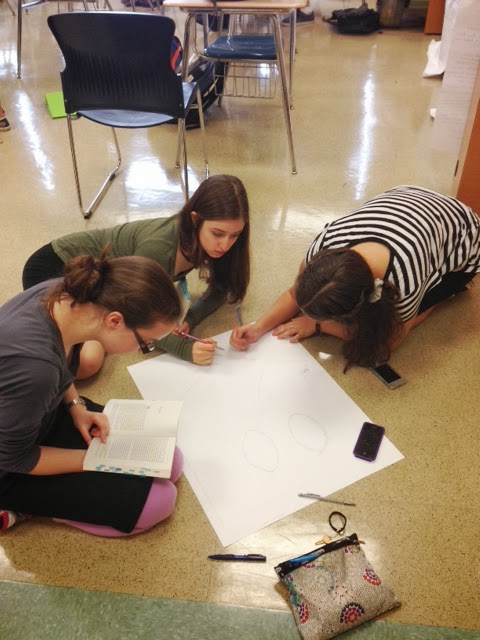
Also make sure students have opportunities to collaborate
Fostering greater engagement in schooling may be achieved not only through structuring activities but also through promoting their connection to students' future goals. This is not to say that all schoolwork should be explicitly linked to future careers, but that the process of developing particular skills and understanding necessary for future success must receive greater emphasis. Currently, school is a place where teenagers typically are assigned tasks rather than being allowed to choose them. Given that schooling is involuntary, a shared sense of purpose between adolescents and adults may be an integral part of fostering engagement in school. To facilitate flow experiences, schools need to create environments in which students understand both the broader purpose of schooling and the specific purpose of individually assigned tasks. Adults can encourage engagement by becoming involved as mentors and advisers to students as they undertake work that challenges their skills. In school, as in other contexts, adults have the responsibility for assuring that the demands made of adolescents have a clearly defined purpose. In addition to providing support to students, adults also need to give them the freedom to direct their own efforts. (164)
* We found the manuscript through David Thornburg who, in this blog post, writes about it and the need for change in education.
Additional resources
We love this edutopia article on the way inquiry-based instruction deepens learning.
Check out the book Flow, also by Mihaly Csikszentmihalyi.


.JPG)
.JPG)
.JPG)


.JPG)